

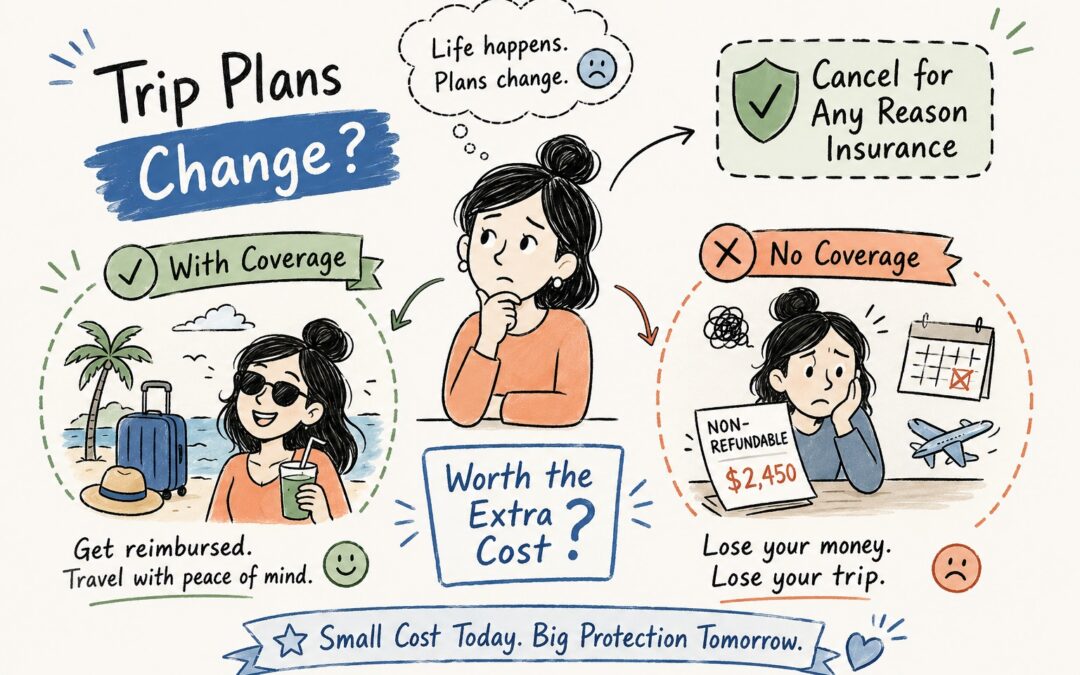
You booked a $5,000 international trip eight months ago. Flights, hotel, a guided tour, and a cooking class in Florence, all paid, all non-refundable. Then, three months out, life shifts. Maybe a work project explodes, a family situation changes, or you simply lose confdence in the destination after watching the geopolitical news. There’s no medical emergency. No death in the family. No natural disaster. Just a legitimate reason that doesn’t appear anywhere in your travel policy’s list of covered cancellation events.
Cancel for any reason insurance exists precisely for this gap. Standard trip cancellation coverage won’t help you when your reason isn’t on the approved list, and that list is shorter than most travelers assume. But cancel for any reason insurance costs more, pays back less than 100%, and comes with strict rules that disqualify plenty of buyers. So the question isn’t just “does it exist?”, it’s whether it actually makes fnancial sense for your specifc trip. This article gives you the numbers, the fne print, and a clear framework to decide. If you want to compare cancellation coverage options before committing, SoEasy Travel Insurance offers a straightforward comparison tool across its trip protection plans, with direct WhatsApp support to walk you through the details.
Cancel for Any Reason Insurance: What It Covers
CFAR is an optional add-on to a standard travel insurance policy. It lets you cancel a trip for any reason at all, including ones that appear nowhere in your policy’s covered-events list. Changed your mind? Nervous about political unrest that hasn’t reached a formal travel advisory? Just don’t want to go anymore? Under CFAR, none of those reasons require justifcation or documentation beyond proof of your prepaid costs.
How standard trip cancellation works first
Standard trip cancellation reimburses 100% of your non-refundable costs, but only for specifc covered reasons: serious illness, death of a family member, jury duty, natural disasters, job loss, and similar events. The list varies by provider, but the key word is “list.” If your reason isn’t on it, the claim is denied. This coverage is not flexible by design. It’s a contract with defned qualifying events.
Where CFAR steps in
CFAR exists because life doesn’t follow a policy’s approved-reasons list. The add-on kicks in for cancellations that don’t qualify under standard coverage. One important detail: if your reason does qualify for standard cancellation (like a documented medical emergency), standard coverage pays out frst at 100%. CFAR is the fallback for everything else, not a replacement for the stronger beneft you already have.
One underappreciated advantage: pre-existing conditions
Unlike standard trip cancellation, CFAR covers cancellations triggered by a pre-existing medical condition. You don’t need to prove medical necessity or meet a look-back window requirement. For travelers managing chronic health issues who want real fexibility without the documentation burden, this distinction matters more than most people realize.
Cancel for Any Reason Insurance: Costs and Payouts
Before deciding whether CFAR belongs in your travel plan, you need concrete numbers. Vague references to “a small additional premium” don’t help you make a decision, specifc fgures do.
What CFAR adds to your base premium
Across major US travel insurers in 2026, CFAR adds roughly 40, 60% to your base policy premium, which works out to approximately 3% of total trip cost. On a $2,500 trip, expect to pay around $79 more. On a $5,000 trip, roughly $191. On a $10,000 trip, closer to $302. Your base travel insurance already runs 4, 8% of trip cost, so total coverage with CFAR included lands somewhere between 6, 14% of what you spent on the trip itself.
What you actually get back if you cancel
This is where the math requires honest attention. CFAR reimburses only 50, 80% of your non-refundable prepaid costs, not the full 100% that standard cancellation provides for covered reasons. Most providers land at 75%. Allianz offers 80% on its OneTrip Prime and Premier plans. Travel Guard sits at the low end with 50%, a meaningful difference at high trip values. On a $5,000 trip with 75% reimbursement, you’d recover $3,750, leaving a $1,250 gap. Factor that shortfall into your decision alongside the cost of the add-on itself. For a readable roundup of highly rated CFAR options, see this best CFAR travel insurance guide.
Fine print rules that determine whether CFAR pays out
Many travelers purchase CFAR and then discover too late that they missed a key eligibility requirement. These aren’t buried clauses, they’re standard industry conditions that apply across nearly every provider. Miss one, and the coverage simply doesn’t apply.
The purchase window is strict
CFAR must be purchased within 10, 21 days of your frst non-refundable trip payment, with 14, 21 days being the most common window. The clock starts from the moment you put down any deposit, not from when you decide to buy insurance. If you booked fights three months ago and are only now thinking about adding CFAR, it’s almost certainly too late. This single rule disqualifes more buyers than any other condition.
You must insure 100% of your prepaid costs
CFAR requires that every dollar of your prepaid, non-refundable trip expense be listed on the policy. Partial coverage isn’t permitted. If you insure $3,000 of a $5,000 trip, CFAR is void. Every fight, hotel deposit, tour booking, and non-refundable reservation must be included in your total insured amount.
Cancellation notice and state restrictions
You must cancel your trip and notify both your insurer and all travel suppliers at least 48 hours before departure (some plans require 72 hours). Cancellations made inside that window fall back to standard covered-reasons territory only. CFAR is not available to residents of New York or Washington state, regardless of which insurer you choose. Residents of those states should note that CFAR is not an option for them regardless of provider.
How major providers compare on reimbursement and price
Not all CFAR policies are equivalent. The differences between providers aren’t just marketing, they translate directly into dollars recovered if you actually cancel.
Reimbursement rates side by side
Allianz offers 80% reimbursement on its OneTrip Prime and Premier plans, and notably allows cancellation up to departure day rather than requiring 48 hours’ notice. Most other major providers, including Seven Corners, Tin Leg, AXA Assistance USA, Travelex, HTH Worldwide, and Travel Insured International, offer 75%. Travel Guard falls to 50%, which is worth knowing before assuming all CFAR policies deliver similar value. On a $10,000 trip, the difference between 50% and 80% reimbursement is $3,000.
Purchase rules and claim processes
Most providers require purchase within 14 days of your frst deposit and at least 48 hours’ cancellation notice before departure. Claim processes are broadly similar across the industry: submit proof of prepaid costs, a cancellation confrmation, and documentation showing no refunds or credits were received, then allow a few weeks for processing. Tin Leg consistently earns strong marks for claims satisfaction. AXA and Travel Guard tend to run higher total premiums when CFAR is included. For a basic primer on how CFAR works and what to expect when fling a claim, NerdWallet’s explanation is helpful: Cancel-for-Any-Reason explained.
For trips to Europe, Asia, or Africa, always confrm the base policy’s medical coverage limits before evaluating the CFAR add-on. The underlying coverage matters just as much as the cancellation fexibility, especially where US health insurance provides little or no protection. You can review provider-level CFAR overviews and typical exclusions on sites that aggregate policy terms, for example InsureMyTrip’s CFAR overview.
When CFAR is genuinely worth the upgrade (and when to skip it)
The honest answer is that CFAR isn’t the right choice for every traveler or every trip. The goal here is to help you identify which category you actually fall into.
Situations where CFAR earns its cost
CFAR makes the most sense when your trip involves large, non-refundable upfront costs and genuine uncertainty about whether you’ll go. Think: a $7,000 safari booked 10 months out, a destination wedding overseas, a multi-stop itinerary across three continents, or a trip during an election year to a region with unpredictable travel conditions. It also suits travelers with health conditions that wouldn’t trigger covered-reason benefts under standard cancellation, but might still prompt a change of plans. If your non-refundable exposure is signifcant and your personal or professional circumstances carry real uncertainty, the 3% cost often makes sense.
When you can comfortably skip it
If your non-refundable costs are modest, the booking is last-minute, or your travel suppliers offer fexible cancellation (many hotels now provide free cancellation within 48, 72 hours), the 3% CFAR cost isn’t justifed. Travelers who’ve already missed the purchase window, residents of New York or Washington, or anyone with fully refundable bookings have no use for this add-on. Standard trip cancellation coverage, which reimburses 100% for qualifying events, is the better value for most straightforward international trips. If you’re trying to decide whether CFAR makes sense for a short itinerary, see Is Travel Insurance Worth It for Short Trips? (2026 Guide) for a focused breakdown.
How to fnd the right cancellation coverage before you commit
Comparing cancel for any reason insurance options without a clear checklist leads to costly mistakes. Here’s how to approach the evaluation practically.
What to compare across policies
-
- Reimbursement percentage:
The difference between 50%, 75%, and 80% is a real dollar gap at high trip values, not a rounding error. - Purchase window:
Verify it matches your booking timeline. If you’ve already made non-refundable payments, check whether you’re still within the eligible period before doing anything else. - Base policy medical coverage:
Confrm limits are adequate for your destination, particularly for trips to Africa or Asia where US health insurance provides little or no coverage. - Total premium as a percentage of trip cost:
Calculate the full cost including CFAR to see whether the protection is proportionate to the risk you’re actually covering.
- Reimbursement percentage:
Getting clear answers before you buy
Policy language isn’t always easy to decode, especially when standard cancellation terms overlap with CFAR add-on conditions. SoEasy Travel Insurance offers cancel for any reason coverage options across its trip protection plans and provides direct WhatsApp support for travelers who want to talk through exactly what’s covered before committing to a policy. If you’re weighing whether CFAR makes sense for an upcoming international trip and want a straight answer without navigating an automated phone system, that kind of personalized access makes a genuine difference. For additional comparisons and policy-by-policy breakdowns, Squaremouth maintains a resources section on CFAR that can be useful: Squaremouth CFAR resources.
Bottom line: run the numbers on your specifc trip
Cancel for any reason insurance is a useful tool with a specifc job. It flls the gap between standard covered-reason cancellation and the unpredictable reality of life. But it costs more, pays back less than 100%, and requires strict timing that many travelers miss.
The key fgures to keep in mind: CFAR adds roughly 3% of trip cost, reimburses 50, 80% of non-refundable expenses (with most providers at 75%), and must be purchased within 14, 21 days of your frst non-refundable payment. For high-value trips with genuine uncertainty built in, it’s a reasonable safety net. For fexible, low-cost, or last-minute bookings, it’s an unnecessary expense.
Before your next international trip, calculate your total non-refundable exposure, check the purchase window from your frst deposit date, and compare reimbursement rates across at least two or three providers. If you have questions about what your cancellation coverage actually covers in practice, reach out to SoEasy Travel Insurance directly via WhatsApp for a clear, jargon-free answer before you commit to anything.
Get a quote now and get ready to pack!