

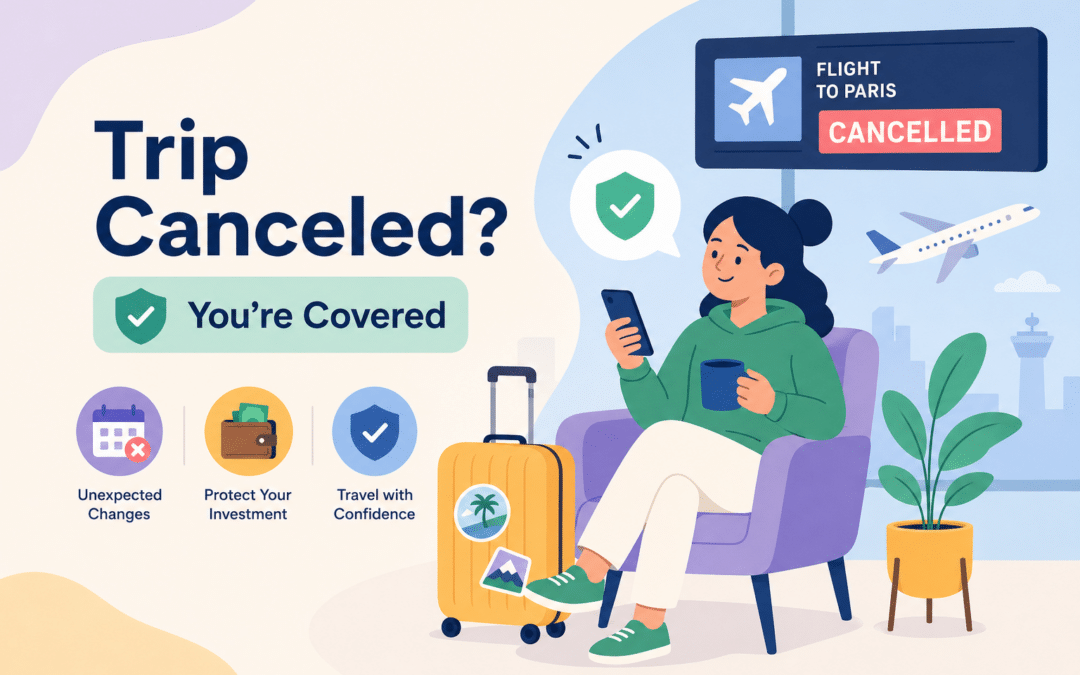
Trip cancellation insurance can be the difference between a $6,000 loss and a full refund. Picture this: you’ve spent months planning a trip to Europe. Flights booked. Hotels paid. A private tour through Tuscany with a nonrefundable deposit. Then, two weeks before departure, you end up in the hospital. Without the right coverage in place, that money is simply gone. Airlines issue credits at best, hotels keep deposits, and tour operators rarely budge.
Trip cancellation insurance reimburses your prepaid, nonrefundable trip costs when an unexpected qualifying event forces you to cancel before you leave home. This is distinct from general travel insurance, which bundles multiple coverages like emergency medical and lost baggage. It’s also separate from trip interruption insurance, which only activates after you’ve already departed. Trip cancellation coverage is specifically about protecting the money you’ve already spent before your trip even begins.
At SoEasy Travel Insurance, trip cancellation is built into standard policies for US travelers, so you won’t need to track it down as a costly add-on. By the end of this article, you’ll know exactly what’s covered, how reimbursement works, what a claim requires, and how to pick the right plan before your next deposit clears.
What Trip Cancellation Insurance Actually Covers (and What It Doesn’t)
Standard trip cancellation policies cover a specific list of unforeseen qualifying events. The most common include sudden serious illness or hospitalization of the traveler or an immediate family member, and death of a traveling companion. For a detailed breakdown and examples from an established insurer, see AXA’s trip cancellation guide.
Additional qualifying reasons typically include severe weather or a natural disaster making the destination unreachable, involuntary job loss after at least one year of employment, mandatory jury duty, military redeployment, financial default of a travel supplier like an airline or tour operator, and your home becoming uninhabitable due to fre or food.
Here’s a concrete example for each of the most common scenarios US travelers face:
-
- Medical emergency
You’re scheduled to fly from Chicago to Rome, but you’re hospitalized with a serious infection ten days before departure. A licensed physician confirms you’re unfit to travel. Your nonrefundable costs are covered. - Severe weather
A hurricane hits your departure hub, your airline cancels fights, and your first hotel night at the destination is nonrefundable. The airline cancellation notice is your documentation. - Job loss
You booked a two-week trip to Southeast Asia while employed. You’re laid off two months before departure and have a formal termination letter in hand. Many policies cover this, provided you meet the minimum employment-duration requirement, commonly one year of continuous employment, and can document the involuntary nature of the termination. - Supplier default
The boutique tour operator you booked through flees for bankruptcy before your trip. Most comprehensive policies cover this scenario.
- Medical emergency
Families and group travelers concerned about nonrefundable deposits can find additional planning guidance in SoEasy’s Budget Family Travel Insurance: Protect Your Trip.
The exclusions are where travelers get caught off guard. Simply changing your mind doesn’t qualify. A mild fu, routine illness, or a pre-existing condition without a waiver won’t be covered. Fear of civil unrest, undeclared war, or pandemic travel restrictions typically fall outside standard coverage. Customs detention and ordinary travel delays are also excluded. These gaps are why many travelers add a Cancel for Any Reason (CFAR) upgrade, which the next section explains in detail.
Trip Cancellation, Trip Interruption, and CFAR: The Real Differences
These three coverage types are frequently confused, and mixing them up leads to unpleasant surprises at claim time. Understanding the distinctions before you buy is the clearest way to know what you’re actually getting.
How Trip Interruption Coverage Differs
Trip interruption insurance activates after departure, not before. If you’re already in Rome when you receive word that a parent has passed away, trip interruption coverage pays for your emergency fight home and reimburses the unused, prepaid portions of the trip you had to cut short. It’s the post-departure counterpart to trip cancellation coverage. Most comprehensive travel insurance policies bundle both together, which means you’re protected on both sides of the departure date with a single policy purchase.
When CFAR Coverage Is Worth Considering
Cancel for Any Reason (CFAR) is an optional upgrade that lets you cancel for literally any reason, including second thoughts, scheduling conflicts, or vague unease about traveling to a particular destination. The trade-offs are real: CFAR reimburses only 50% to 75% of nonrefundable costs, compared to 100% reimbursement under standard trip cancellation insurance for a qualifying reason. It costs more upfront, and you must purchase it within 10 to 21 days of your first trip deposit. You also need to cancel at least 48 to 72 hours before departure to activate the benefit.
For travelers booking expensive, mostly nonrefundable international itineraries with genuine uncertainty about whether the trip will happen, CFAR provides real peace of mind. For travelers with a clear, documented qualifying reason, standard cancellation coverage at 100% reimbursement is the better value.
How Much You Can Expect to Get Back
Standard trip cancellation policies reimburse 100% of prepaid, nonrefundable costs when the cancellation reason qualifies and is properly documented. If you insure a $7,000 trip and cancel due to a confirmed medical emergency, you receive $7,000 back. The whole point of the coverage is to make you financially whole.
With CFAR, the math changes significantly. That same $7,000 trip yields a reimbursement of $3,500 to $5,250, depending on whether the policy pays 50% or 75%. Here’s a side-by-side comparison:
-
- $7,000 trip, standard cancellation (qualifying reason):
$7,000 reimbursed - $7,000 trip, CFAR at 75%:
$5,250 reimbursed - $7,000 trip, CFAR at 50%:
$3,500 reimbursed
- $7,000 trip, standard cancellation (qualifying reason):
Cancellation reimbursement only applies to costs you can’t recover directly from the supplier. Refundable hotel bookings, redeemable airline credits, and costs paid with points or miles are excluded from the calculation. Pursue refunds from airlines, hotels, and tour operators first. Travel protection insurance covers the gap that remains after those efforts, not the full trip cost regardless of what you’ve already recovered.
Is Your Credit Card’s Cancellation Benefit Enough?
Premium travel cards like the Chase Sapphire Reserve and the American Express Platinum do include trip cancellation benefits. These are genuine protections worth knowing about. According to each card’s Guide to Benefits, the Chase Sapphire Reserve covers up to $10,000 per covered trip, and the American Express Platinum offers up to $10,000 per covered trip. Both require that you charged the full trip cost to that card to activate the benefit. (Specific limits and eligible reasons vary; always check your current card benefit guide before relying on this coverage.) For details on Chase’s coverage specifics, see Chase’s Sapphire travel insurance guide.
The limitations matter. Credit card benefits cover a short list of qualifying reasons, typically illness, severe weather, carrier default, and jury duty. Pre-existing conditions are excluded, and there’s no CFAR upgrade path. For a short domestic trip under $5,000 with mostly refundable bookings and a healthy traveler, a credit card benefit may genuinely be sufficient. That’s the scenario where the math works.
Beyond that low-cost domestic use case, a standalone policy is more appropriate. For international trips over $10,000, multi-destination itineraries, travelers with pre-existing health conditions, or anyone booking heavily nonrefundable packages, standalone trip cancellation insurance offers meaningfully broader protection. The coverage ceiling is higher, the list of qualifying reasons is longer, CFAR is available as an upgrade, and emergency medical coverage is bundled in. The cost typically runs 4% to 10% of total trip cost, a predictable number you can factor into your travel budget from the start. (Premiums vary based on age, destination, and policy limits, so treat that range as a planning benchmark rather than a guarantee.) For a side-by-side look at credit card vs. standalone policy considerations, see Allianz’s guide to choosing credit card travel insurance.
Filing a Trip Cancellation Insurance Claim: What You’ll Need and How Long It Takes
Every claim, regardless of reason, needs three things: proof of the trip, proof of what you paid, and proof of the qualifying event. That means a trip itinerary or booking confirmation, paid invoices or credit card statements, cancellation confirmations from each supplier, and documentation specific to your reason for canceling.
Documentation requirements by scenario
- Medical emergency
A completed claim form, a physician’s statement confirming diagnosis and that travel was inadvisable, medical records or treatment proof, and cancellation confirmations from all suppliers. - Death of a family member
A death certificate, proof of the family relationship, and the full set of trip documentation above. - Job loss
A formal termination letter from your employer with the effective date, proof of continuous employment prior to booking, and trip receipts showing nonrefundable costs. - Weather or natural disaster
Official weather service alerts, government advisories, or airline cancellation notices confirming the event directly affected your travel.
Many insurers process trip cancellation claims within four to six weeks of receiving a complete submission, though timelines vary by provider. Incomplete documentation is the primary cause of delays, so fling online and uploading everything at once is the fastest path to resolution. SoEasy Travel Insurance offers customer support via WhatsApp and email, so you can get guidance on gathering the right documents before you submit, not after a claim gets fagged for missing information. Check SoEasy’s current support terms for details on availability and response times.
How to Choose the Right Trip Cancellation Insurance Before Your Next Deposit
Three things matter most when comparing policies: the list of qualifying cancellation reasons (comprehensive plans often include 20 or more), the reimbursement ceiling relative to your total trip cost, and the purchase window for CFAR if you want that option. Timing is critical. Buy your policy soon after paying your first trip deposit, not the week before departure. Pre-existing condition waivers and CFAR options are typically only available within 14 to 21 days of that first payment. Miss that window and those protections are simply off the table.
Also check whether the policy covers supplier default, and consider rolling that check into your broader policy comparison rather than treating it as an afterthought. Most travelers don’t think about this until a small airline or boutique tour operator goes under, taking nonrefundable deposits with them. It’s a scenario that matters more than most travelers realize, particularly when booking with independent operators outside the US.
SoEasy Travel Insurance includes trip cancellation as part of its standard policy coverage for US travelers heading to international destinations like Europe, Africa, and Asia, meaning you’re not paying extra for a core protection that should be there from the start. For specifics on what’s included and when coverage begins, review the policy terms or speak with the SoEasy team directly. Learn more about planning a trip to Europe with appropriate coverage in Traveling to Europe? Travel Insurance & a stress-free trip!
The Bottom Line on Protecting Your Trip Investment
Back to that Chicago traveler with the $6,000 Europe itinerary. A hospitalization two weeks before departure is devastating enough on its own. Losing the money on top of it doesn’t have to happen. With the right trip cancellation insurance in place, purchased within days of paying that first deposit, the financial loss is recoverable. The trip can be rescheduled. The money comes back.
Trip cancellation insurance is one of the most straightforward forms of travel protection available. It covers a predictable set of risks with predictable reimbursement, provided you buy at the right time and understand what qualifies. The credit card comparison, the CFAR trade-off, and the documentation checklist all point to the same conclusion: know what you’re buying before you need it.
The window to add CFAR or a pre-existing condition waiver closes faster than most travelers expect, often within two weeks of that first deposit. Get your quote from SoEasy Travel Insurance before your next payment clears, and compare what’s included as standard versus what costs extra. If you’d like a concise refresher before you shop, read Understanding Travel Insurance Basics for Your Trip. A policy built around real trip cancellation coverage, with accessible support when you need to use it, is what turns an expensive international trip from a financial gamble into a reasonable risk worth taking
Get a quote now and get ready to pack!